
Flexible 80A Resin
Engineering
SLA
Flexible
83 A
230 %
28 kN/m
Select Printer Series and Resin Volume
| Bulk order quantity (L) | Discount % |
|---|---|
| 1 | 0% |
| 30 | 15% |
| 60 | 20% |
| 120 | 25% |
| 240 | 30% |
| 1,000 | 35% |
| 2,000 | 40% |
| 3,000 | 45% |
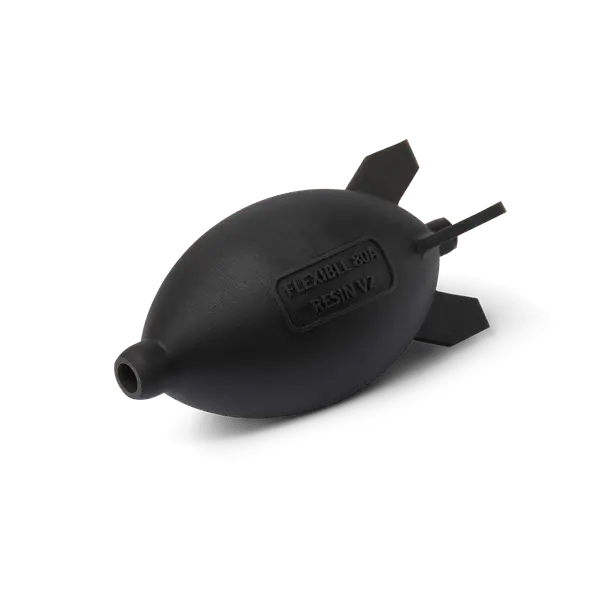
Flexible 80A Resin V2 is a resilient 3D printing elastomer that rivals the look, feel, and function of 80A cast urethanes, TPUs, and hard rubbers.
Parts printed in Flexible 80A Resin V2 snap back into place and withstand repeated bending, tension, and compression. Create tear-resistant functional prototypes and end use parts, protect sensitive components with soft inserts and fixtures, or design refined padding and grips with tack-free surfaces and a matte, black finish.
Flexible 80A Resin V2 is a new material formulation that leverages the technology of Form 4 Series printers to deliver 2x higher tear strength, 2x higher elongation at break, 4x higher rebound, and improved aesthetics and aging compared to the previous version.
Flexible 80A Resin has been added to your cart.
Why Choose Flexible 80A Resin?
Resilient elastomeric material that rivals the look, feel, and function of 80A cast urethanes, TPUs, and hard rubbers.
Exceptionally High Rebound
Resilient parts that snap back to shape with a 56% pendulum rebound, comparable to 80A cast urethanes.
Tough and Tear-Resistant
Create durable, stretchable parts that resist failure with a tear strength of 28 kN/m and elongation at break of 230%, 2x higher than the previous generation.
Looks and Feels Like a Cast Urethane
Functional prototypes and end-use parts with cast-urethane quality that matches the look and feel of traditional urethanes with a matte, black appearance and tack-free surfaces.
Fatigue-Resistant, Long-term Performance
Create long-lasting connectors, fixtures, and covers that survive 5x more cycles (Ross Flex fatigue) compared to the previous generation and retain 87% of their initial elongation at break after 1000 hours of accelerated indoor aging.
Applications
| Flexible 80A Resin V2 | Cast Urethane (Smooth-on Task™ 16) | |||
|---|---|---|---|---|
| Hardness (Shore A) | 83A | 80A* | ||
| Tear Strength | 28 kN/m | 160 pli | 34.5 kN/m | 197 pli* | ||
| Elongation at Break | 230% | 233%* | ||
| Pendulum Rebound (Schob Type) | 56% | 54% | ||
| Ross Flex Fatigue | 12,800 cycles** | 38,600 cycles** |
*Value reported by manufacturer and not tested directly by Formlabs
**Internally tested with no environmental control
Compare Formlabs Flexible Resins
Flexible 80A Resin V2

Key Characteristics
Resilient and tear-resistant
Comparable to
80A cast urethanes and hard rubbers
Recommended Applications
Resilient bumpers and enclosures, soft inserts and fixtures, shock-absorbing padding and grips, seals and gaskets
Flexible 50A Resin

Key Characteristics
Pliable and transparent
Comparable to
Soft rubbers and silicones
Recommended Applications
Compliant features, compressible buttons, soft tissue anatomy and medical models
Silicone 40A Resin

Key Characteristics
True silicone, excellent chemical and thermal resistance
Comparable to
Cast silicones
Recommended Applications
Seals and gaskets, wearables, customized medical devices
Post-Processing
Washing
The foundational step in any SLA post-processing workflow is to remove any excess resin on the surface of the parts through a solvent.
Use clean ≥ 90% IPA to wash Flexible 80A Resin V2. Flexible 80A Resin V2 is not compatible with Formlabs Resin Washing Solution.
For the best surface finish, Formlabs recommends allowing parts printed in Flexible 80A Resin V2 to air dry for at least 30 minutes after washing, before handling.
Curing
Post-curing Engineering and Specialty Resins is essential for parts to achieve their full strength and functionality. This step completes the chemical reaction initiated during printing, transforming the part from its green state into a fully finished component.
Flexible 80A Resin V2 has a two-step curing process that ensures tack-free surfaces. Cure parts submerged in a water bath in a UV transparent container at room temperature. After drying, cure in air at elevated temperature. See the links below for the specific settings.
